
PhD - Economics | JNU - New Delhi
PhD - Business Analytics | IIT - Kharagpur
In a rapidly digitising economy, a significant number of entry-level jobs are expected to be displaced by Artificial Intelligence (AI) by the mid-2030s. Simultaneously, the gap between the skills workers possess and those businesses demand continues to widen. Workers often lack awareness of their career’s vulnerability to AI, and even when aware, face systemic, financial, and psychological barriers to upskilling. At a broader level, public policy must raise awareness about AI-related job risks and support large-scale upskilling efforts. Parallely, individuals require personalised guidance to navigate career transitions and build long-term resilience.
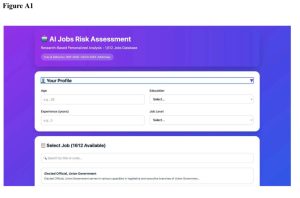
This project maps occupations in India by their AI risk and recommends upskilling strategies for high-risk roles. Using the 2008 and 2015 NCO editions and global reports (ILO, OECD, WEF, Frey & Osborne, McKinsey), we developed a research-based AI Risk Scoring Engine that evaluates task-level vulnerability and incorporates individual factors such as age, education, experience, and job level. These insights are presented through a web-based pilot that provides personalised risk assessments and upskilling suggestions, with reskilling recommendations offered when needed. Alongside the platform, a policy brief translates the findings into macro-level recommendations for government, educational institutions, and employers. By combining individual-level guidance with system-level policy insights, the project aims to strengthen workforce resilience and contribute to national conversations on the future of work.
The final solution created in this project is a browser-based AI Risk Assessment Tool which determines the vulnerability of different occupations in India to the risk of AI-driven automation. The tool integrates research-grounded automation frameworks (from the literature review identified) with the Indian National Classification of Occupations (NCO), 2015 jobs database to generate a final AI Risk Score, Scoring calculation/breakdown, Analysis, Key factors, Comparable Roles and Strategies.