
PhD | Indira Gandhi Institute of Development Research (IGIDR) - Mumbai

PhD - Statistics | Indian Statistical Institute - Kolkata
India’s rapid urbanisation and growing population continue to add a lot of stress on the country’s energy supplies and are making it more dependent on non-renewable energy sources. At the same time, the rise in AI use around the world is expected to quadruple the power demand from data centres, reaching over 945 TWh by 2030. This makes it very important to switch to a renewable sources of energy like solar power. The installations are mostly in five states, and by January 2025, there will be about 16 gigawatts (GW) installed. This is less than the national goal of 30 GW by 2027 (International Energy Agency, 2024). The main problems are high installation costs, lack of awareness about financing options, subsidies and schemes, and problems with the policy approval and implementation process. Our policy paper will seek to pinpoint inconsistencies between policy frameworks and consumer experiences while also offering policy suggestions and implementation plans to boost the use of rooftop solar energy in different socio-economic and regional contexts in India. Additionally, the dashboard aims to make it easier, clearer, and more affordable for Indian homes to switch to solar power.
The project offers a two-part solution – a policy brief and a dashboard. This brief examines why Indian households adopt or avoid rooftop solar, reviews the performance of major national programmes, and compares them with international approaches. It shows that financial benefits alone are not enough and that awareness gaps, administrative delays and uneven state regulations limit adoption. It recommends nationwide consumer outreach regulatory standards to improve trust, reduce barriers and strengthen residential uptake.
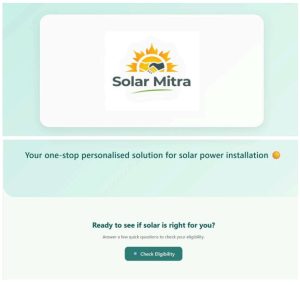
The dashboard takes this one step further by turning insights from the policy brief into a visual tool. The dashboard helps users to check their eligibility, look for financing and vendor options and understand their solar output potential. The dashboard combines four main components. First, an eligibility checker that evaluates rooftop area, location, unit electricity and income range to suggest subsidies, procedures and financing options. This component uses the government’s solar rooftop yojana to understand what the categories are that are mandatory to be checked according to the government guidelines. Second, we have a financing engine that integrates loan schemes from different banks to calculate EMI structures, payback periods, monthly savings and benefits. This component is designed to address the confusion around the financial viability of installing solar panels. Third, we have a vendor list panel that helps users identify verified installers area-wise. This feature was designed because many people struggle to find trustworthy vendors and check whether the installer is MNRE-registered. Instead of going through multiple websites or depending on word of mouth, users get a verified end-to-end platform.