
PhD - Film Studies | The English and Foreign Language University (EFLU) - Hyderabad
PhD - The New School for Social Research | New York - USA
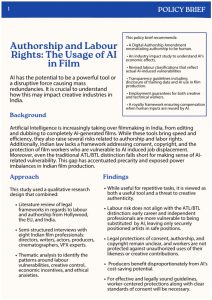
The emergence of Artificial intelligence (AI) has created both opportunities and challenges for the creative economy, particularly within the film industry. From algorithm-based editing tools and AI-enabled dubbing to the unauthorized replication of actors’ voices and likenesses, these technologies are transforming how films are made and marketed, and in the process, altering the roles of film professionals and workers. However, this period of change is underpinned by unregulated AI usage weakening the creative and labour rights of stakeholders due to an uncertainty in copyright and authorship laws. Indian labour and legal framework needs to evolve to regulate and accommodate AI-enabled alterations of cinematic works to protect the aforementioned creative and labour rights of film based creative professionals and workers. This research thus examines what factors need to be considered to frame a policy in this domain.
This study examines AI’s integration into film production globally with a specific focus on Indian cinema, and the implications on intellectual property, authorship, copyright law, and labour laws to address changes brought by AI. As a precedent for Indian cinema, this research explores how governments and regulatory bodies globally are responding to the AI induced changes. For this purpose, Hollywood, which is one of the largest film producing industries, as well as Europe, are examined for their legal frameworks. To further understand this, this research employs a two fold approach. This includes a comprehensive review of the contemporary academic debates, judicial precedents, and policy papers on the integration of AI and film, along with primary qualitative interviews conducted with creative professionals across directing, producing, acting, cinematography, VFX, and casting in the Indian film industry. The insights from these interviews were thematically analysed, revealing key concerns around AI as either a tool or an author, economic vulnerabilities, risks of creative homogenization, and the unethical uncertainty surrounding consent, rights, and ownership.
The proposed solution is a policy brief making recommendations to the existing legal framework with the purpose of explicitly addressing AI-enabled alterations. Additionally, the brief advocates for collaborative frameworks between the film industry and the state to formulate standards that maintain creative integrity while enabling ethical technological integration. By situating the problem within the intersecting fields of law, ethics, and labour in creative industries, this research aims to contribute to an urgently needed discourse on regulating AI in Indian cinema, while also emphasizing the need for human-centric authorship, consent-based AI usage, protection of film workers, and clearer regulatory structure that is capable of responding to the rapidly changing technological environment.